
Roundups
The Best Prayer Times Apps in 2026 (Adhan, Qibla & Accuracy)
Which prayer times app is most accurate, which handles the Qibla best and which one you should install — ranked by what each does better, including where our own app places.
In short
If your mosque publishes its timetable, MAWAQIT is the most accurate choice by definition — it shows the jamaah times your mosque actually announced instead of a calculation. Athan is the strongest calculated option and has the widest location coverage. Tariq is the one to pick if you want prayer times and Qibla alongside daily Quran reading and a habit streak, with no ads. Muslim Pro covers everything but shows ads on the free tier.
- 1
MAWAQIT
Best for your local mosque's actual jamaah times
Best for: Free, no ads, and unmatched for the prayer times of your actual local mosque rather than a calculation.
The trade-off: Focused on mosque schedules: there is no full Quran reading experience, tafsir or habit tracking.
- 2
Athan
Best calculated times and adhan notifications
Best for: Strong, reliable prayer-time and adhan notifications, backed by IslamicFinder's long-running database.
The trade-off: Built around prayer times first; the Quran reading experience is secondary and the free tier shows ads.
- 3
Tariq
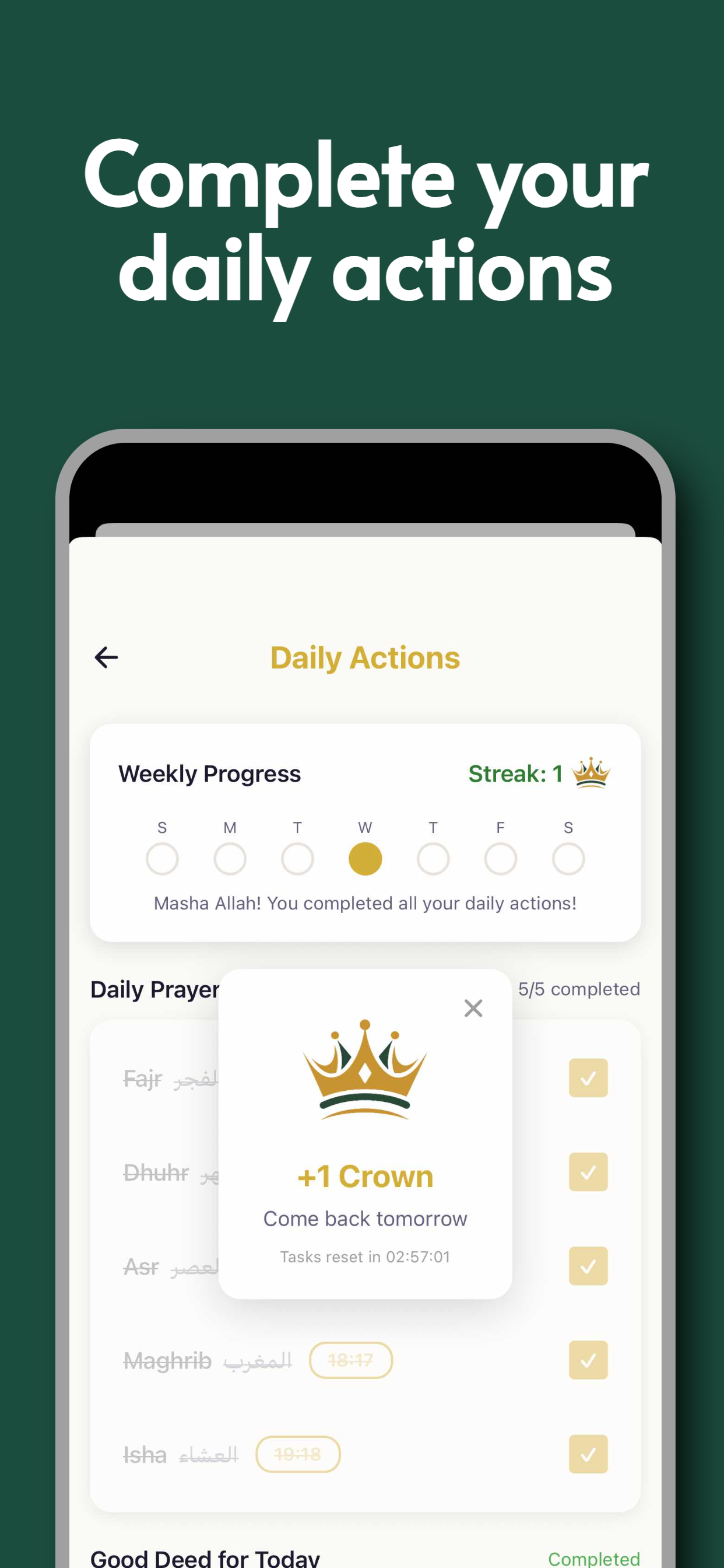
Best if you want prayer times and the Quran in one ad-free app
Best for: Turning reading and praying into a daily habit you actually keep, in a calm ad-free app.
The trade-off: Newer and smaller than the household names, with a deliberately narrow feature set.
- 4
Muslim Pro
Best all-in-one, if you don't mind ads or pay to remove them
Best for: The most complete all-rounder, with the largest library, audio recitations and a huge user base.
The trade-off: The free tier carries ads, and the sheer breadth of features makes the app busy if all you want is to read and pray.
Side by side
| Tariq | MAWAQIT | Athan | Muslim Pro | |
|---|---|---|---|---|
| Full Quran with translation | Yes | No | Yes | Yes |
| Transliteration (read without Arabic) | Yes | No | Partly | Yes |
| Verse-by-verse tafsir | Yes | No | Partly | Partly |
| Prayer times & adhan reminders | Yes | Yes | Yes | Yes |
| Qibla compass | Yes | Yes | Yes | Yes |
| Duas & hadith | Yes | No | Yes | Yes |
| Habit streak & daily actions | Yes | No | Partly | Partly |
| Home & Lock Screen widgets | Yes | Yes | Yes | Yes |
| No ads, ever | Yes | Yes | No | No |
| Works offline | Partly | Partly | Partly | Partly |
Competitor details are taken from their public App Store listings and websites and were last checked on the date shown. Apps change — check the store listing before you decide. — Last checked:
Accuracy is a setting, not an app
Every calculated app on this list uses the same astronomy. The visible differences come from two settings: the convention used for the Fajr and Isha sun angles, and the juristic school used for Asr. Set both to match your local mosque and the apps converge to within a minute or two of each other.
This is why 'which app is most accurate' is usually the wrong question. The right one is: does this app let me match my mosque, and does it recalculate when I travel? MAWAQIT sidesteps the problem entirely by publishing the mosque's own timetable.
What actually differs
Notifications: whether the adhan fires reliably in the background, and whether you can silence a specific prayer without silencing all five. Qibla: whether the compass corrects for magnetic declination or hands you a raw bearing. Travel: whether times follow your location automatically.
And then the question behind the question — do you want a prayer app, or do you want the prayer to be part of something you keep up daily? If it is the second, the app you want is the one with the Quran and the streak attached.
Common questions
Why do two apps show different prayer times for the same city?
Because they are using different calculation conventions. Fajr and Isha depend on how far below the horizon the sun is taken to be, and authorities set that angle differently — which can move those two prayers by fifteen minutes or more. Asr differs by juristic school. Match both settings to your local mosque and the discrepancy disappears.