
For you
A Quran App for People Who Don't Read Arabic
You can read the Quran today without reading Arabic. Here is how transliteration, translation and tafsir work together, and what to look for in an app that takes non-Arabic readers seriously.
In short
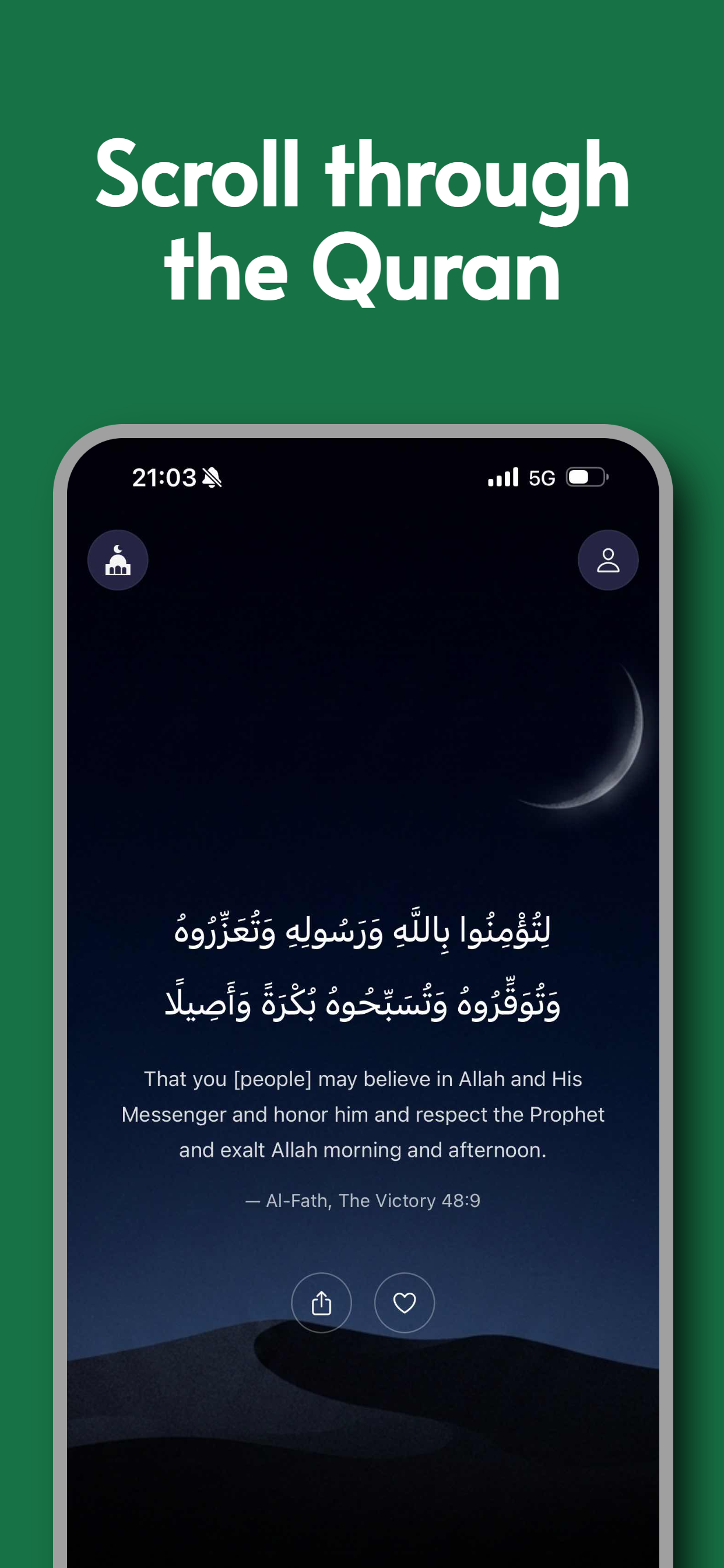
Use an app that shows three layers on the same screen: the Arabic, a transliteration writing those sounds in your alphabet, and a translation — with a short tafsir for context. Recite from the transliteration, understand from the translation, and let the Arabic become familiar by sitting next to both. You do not need to wait until you can read the script.
What each layer is actually for
Transliteration is for your mouth: it lets you recite the Arabic correctly before you can read the script. Translation is for your understanding. Tafsir is for the gap between the two — the verse whose words are clear but whose meaning depends on knowing when and why it was revealed.
Apps that offer only translation leave you understanding the Quran but never reciting it. Apps that offer only Arabic leave you reciting sounds you can't follow. You want all three on the same screen, not in three different menus.
Reading by theme instead of by surah
If Arabic isn't your language, the traditional route — start at Al-Fatiha and work forward — is unusually hard, because you lose the thread quickly in the long early surahs. Browsing by theme instead lets you read what connects to your life this week: patience, gratitude, hardship, forgiveness.
This is not a lesser way to read. It is how most people actually sustain a reading habit in a second language, and it builds the familiarity that makes sequential reading possible later.
Common questions
Is it acceptable to read the Quran in translation?
Reading a translation is how you understand the Quran, and scholars have produced them for exactly that purpose for centuries. A translation is understood as a rendering of the meaning rather than the Quran itself, which is why apps show it beside the Arabic rather than instead of it. If you have a question specific to your situation, ask a scholar you trust.